
Tag: South African Law

What Your Google Search Can’t Tell You About Your Legal Rights

Elandri BrecherAttorney · Debt Review, General Litigation, Wills & Deceased Estates, Family, Commercial, Contract and Labour Law It usually starts the same way. Something goes wrong — a landlord won’t return a deposit, a spouse stops paying maintenance, a business partner disappears with the books — and instead of calling an attorney, the first move is to open Google. Or ChatGPT. Or a Facebook group with 40,000 members and a name like “South African Legal Advice.” Within minutes, there’s a template, a WhatsApp voice note from a cousin’s friend, and a confident answer to a question that was never really understood in the first place. The problem isn’t that people

Read More »

The most expensive documents you never signed

Pumlile MakalimaAdmitted Attorney of the High Court of South Africa · Banking & Finance Department, Hammond Pole Attorneys Some of the costliest legal mistakes people make have nothing to do with a bad contract. They come from having no contract at all. When there is no document to point to, there is no record of what was agreed, no proof of intention, and often no protection when things go wrong. Below are five situations where the absence of a signed agreement tends to cause the most damage — emotionally and financially. 1 Business partnerships without agreements Many businesses start on a handshake between friends or family, with everyone assuming the

Read More »

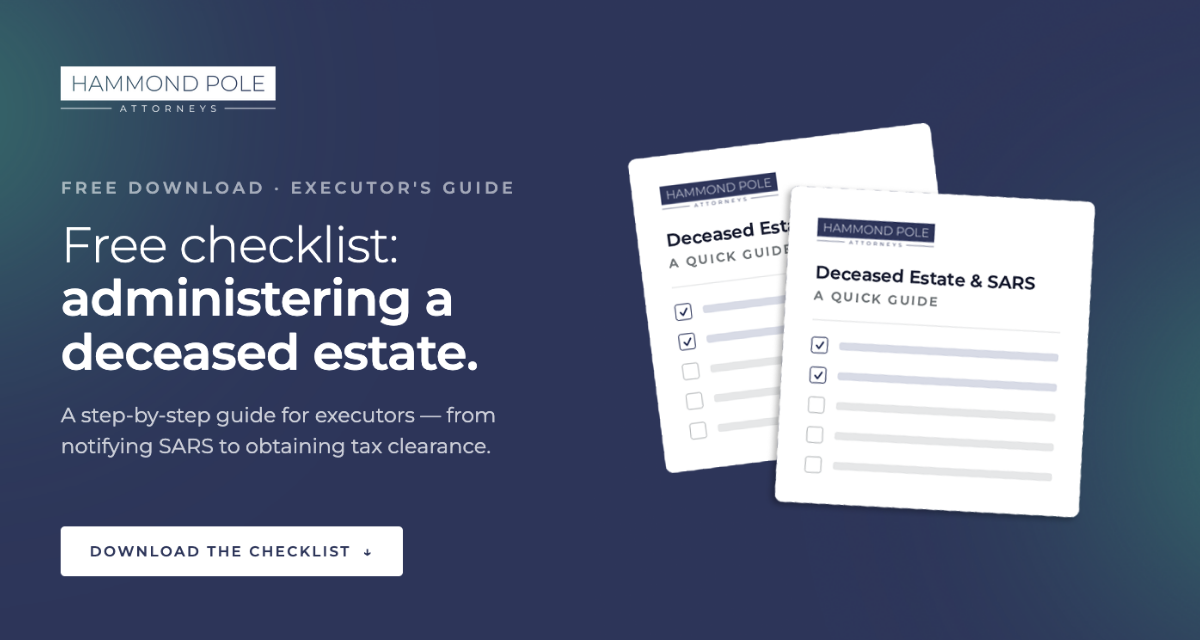
Can SARS claim money from a deceased estate?

Elandri BrecherAttorney specialising in Debt Review, General Litigation, Wills & Deceased Estates, Family, Commercial, Contract, and Labour Law. What Happens When Someone Dies? When a person passes away, their assets and liabilities are consolidated into what is known as a deceased estate. An executor, appointed by the Master of the High Court, is responsible for identifying assets, paying creditors and ultimately distributing the remaining estate to beneficiaries. One of the executor’s key responsibilities is ensuring that the deceased’s tax affairs are brought up to date. SARS must be notified of the death, and all outstanding tax returns must be submitted before the estate can be finalised. What Can SARS Claim?

Read More »

Directors: Understanding Your Fiduciary Duties and Personal Liability Under the Companies Act

Chris NdunaAttorney, Notary and Conveyancer The Legislative Foundation Sections 76 and 77 of the Companies Act set out the standards of conduct expected from directors and the circumstances under which they may be held accountable. Whether you serve on the board of a small family business, a growing SME, or a large corporate organisation, understanding these obligations is essential. Companies Act 71 of 2008 — Key Sections: Section 76 — Standards of directors’ conduct: good faith, proper purpose and the best interests of the company. Section 77 — Liability of directors and prescribed officers for breaches of duty, reckless or fraudulent trading, and misuse of company assets. Fiduciary Duties: The

Read More »

Latent defects in property sales

What Is a Latent Defect? A latent defect is a hidden fault in a property that existed at the time of sale, was not visible or reasonably discoverable during a normal inspection, and materially affects the property’s value or usability. Unlike patent defects, which are clearly visible during an inspection, latent defects only become apparent later — often after the purchaser has already taken occupation. Examples of latent defects Leaking underground pipes Faulty wiring behind walls Rising damp concealed by paint Roof leaks in heavy rain Structural instability Concealed plumbing defects The Seller’s Duty to Disclose In South African property law, a seller is generally expected to act honestly and

Read More »

Why an Offer to Purchase Is Important When Buying a House in South Africa

Buying a home is one of the biggest financial decisions most South Africans will ever make. Understanding the OTP can help buyers and sellers avoid costly mistakes and legal disputes. What is an Offer to Purchase (OTP)? An Offer to Purchase is a formal legal document used when buying or selling property in South Africa. It outlines the terms and conditions under which the buyer wishes to purchase the property. The OTP usually includes six important facts and once both parties sign the OTP, it becomes legally binding. What an OTP includes The purchase price Deposit details Occupation date Payment terms Conditions before sale proceeds Details of buyer and seller

Read More »

Financial Year-End Compliance: A Commercial Law Checklist For Directors And Business Owners

Financial year-end compliance: a commercial law checklist for directors and business owners As the financial year draws to a close, businesses face more than accounting deadlines. Year-end is a critical legal compliance milestone. It is one that directly affects directors’ duties, corporate governance, tax exposure, contractual risk and long-term commercial strategy. Taking a proactive commercial-law approach now can prevent regulatory penalties, shareholder disputes, cash-flow strain and reputational damage later. Below is a structured legal compliance guide to help your business close the year correctly and enter the new one on solid footing. 1. Annual Returns & Statutory Compliance Every registered company and close corporation must ensure that statutory obligations are up

Read More »

When Is A Power Of Attorney Valid in South Africa?

When is a Power of Attorney valid in South Africa? A Power of Attorney (POA) is one of the most frequently used legal instruments in both personal and commercial matters. Whether you are transferring property, managing financial affairs while abroad, or authorising someone to act on your behalf in a specific transaction, a POA is a practical and powerful tool. However, a POA is only valid if certain legal requirements are met, and it can terminate automatically, sometimes without the parties realising it. Understanding when a POA is valid, and when it is not, is essential to avoid costly delays and disputes.   What is a Power of Attorney? A

Read More »

Candidate Legal Practitioners – 2027 Intake

Hammond Pole Attorneys invites applications from high-calibre final-year LLB students and recent graduates for Candidate Legal Practitioner positions commencing in 2027. We are a dynamic and growing law firm, serious about service and committed to delivering practical, solution-driven legal services. Our practice offers candidate legal practitioners exposure to meaningful responsibility, hands-on legal work, and professional mentorship within a demanding but supportive environment. Application Requirements Interested candidates are required to submit an application by email with the following mandatory format and documentation: Email subject line (strictly): CLP – HP – Initial and Surname Email address for submission: Employment <employment@hpd.co.za> Attachments (in PDF format): Detailed Curriculum Vitae Full academic record Proof of

Read More »

What Your Google Search Can’t Tell You About Your Legal Rights

Elandri BrecherAttorney · Debt Review, General Litigation, Wills & Deceased Estates, Family, Commercial, Contract and Labour Law It usually starts the same way. Something goes wrong — a landlord won’t return a deposit, a spouse stops paying maintenance, a business partner disappears with the books — and instead of calling an attorney, the first move is to open Google. Or ChatGPT. Or a Facebook group with 40,000 members and a name like “South African Legal Advice.” Within minutes, there’s a template, a WhatsApp voice note from a cousin’s friend, and a confident answer to a question that was never really understood in the first place. The problem isn’t that people

Read More »

The most expensive documents you never signed

Pumlile MakalimaAdmitted Attorney of the High Court of South Africa · Banking & Finance Department, Hammond Pole Attorneys Some of the costliest legal mistakes people make have nothing to do with a bad contract. They come from having no contract at all. When there is no document to point to, there is no record of what was agreed, no proof of intention, and often no protection when things go wrong. Below are five situations where the absence of a signed agreement tends to cause the most damage — emotionally and financially. 1 Business partnerships without agreements Many businesses start on a handshake between friends or family, with everyone assuming the

Read More »

Can SARS claim money from a deceased estate?

Elandri BrecherAttorney specialising in Debt Review, General Litigation, Wills & Deceased Estates, Family, Commercial, Contract, and Labour Law. What Happens When Someone Dies? When a person passes away, their assets and liabilities are consolidated into what is known as a deceased estate. An executor, appointed by the Master of the High Court, is responsible for identifying assets, paying creditors and ultimately distributing the remaining estate to beneficiaries. One of the executor’s key responsibilities is ensuring that the deceased’s tax affairs are brought up to date. SARS must be notified of the death, and all outstanding tax returns must be submitted before the estate can be finalised. What Can SARS Claim?

Read More »

Directors: Understanding Your Fiduciary Duties and Personal Liability Under the Companies Act

Chris NdunaAttorney, Notary and Conveyancer The Legislative Foundation Sections 76 and 77 of the Companies Act set out the standards of conduct expected from directors and the circumstances under which they may be held accountable. Whether you serve on the board of a small family business, a growing SME, or a large corporate organisation, understanding these obligations is essential. Companies Act 71 of 2008 — Key Sections: Section 76 — Standards of directors’ conduct: good faith, proper purpose and the best interests of the company. Section 77 — Liability of directors and prescribed officers for breaches of duty, reckless or fraudulent trading, and misuse of company assets. Fiduciary Duties: The

Read More »

Latent defects in property sales

What Is a Latent Defect? A latent defect is a hidden fault in a property that existed at the time of sale, was not visible or reasonably discoverable during a normal inspection, and materially affects the property’s value or usability. Unlike patent defects, which are clearly visible during an inspection, latent defects only become apparent later — often after the purchaser has already taken occupation. Examples of latent defects Leaking underground pipes Faulty wiring behind walls Rising damp concealed by paint Roof leaks in heavy rain Structural instability Concealed plumbing defects The Seller’s Duty to Disclose In South African property law, a seller is generally expected to act honestly and

Read More »

Why an Offer to Purchase Is Important When Buying a House in South Africa

Buying a home is one of the biggest financial decisions most South Africans will ever make. Understanding the OTP can help buyers and sellers avoid costly mistakes and legal disputes. What is an Offer to Purchase (OTP)? An Offer to Purchase is a formal legal document used when buying or selling property in South Africa. It outlines the terms and conditions under which the buyer wishes to purchase the property. The OTP usually includes six important facts and once both parties sign the OTP, it becomes legally binding. What an OTP includes The purchase price Deposit details Occupation date Payment terms Conditions before sale proceeds Details of buyer and seller

Read More »

Financial Year-End Compliance: A Commercial Law Checklist For Directors And Business Owners

Financial year-end compliance: a commercial law checklist for directors and business owners As the financial year draws to a close, businesses face more than accounting deadlines. Year-end is a critical legal compliance milestone. It is one that directly affects directors’ duties, corporate governance, tax exposure, contractual risk and long-term commercial strategy. Taking a proactive commercial-law approach now can prevent regulatory penalties, shareholder disputes, cash-flow strain and reputational damage later. Below is a structured legal compliance guide to help your business close the year correctly and enter the new one on solid footing. 1. Annual Returns & Statutory Compliance Every registered company and close corporation must ensure that statutory obligations are up

Read More »

When Is A Power Of Attorney Valid in South Africa?

When is a Power of Attorney valid in South Africa? A Power of Attorney (POA) is one of the most frequently used legal instruments in both personal and commercial matters. Whether you are transferring property, managing financial affairs while abroad, or authorising someone to act on your behalf in a specific transaction, a POA is a practical and powerful tool. However, a POA is only valid if certain legal requirements are met, and it can terminate automatically, sometimes without the parties realising it. Understanding when a POA is valid, and when it is not, is essential to avoid costly delays and disputes.   What is a Power of Attorney? A

Read More »

Candidate Legal Practitioners – 2027 Intake

Hammond Pole Attorneys invites applications from high-calibre final-year LLB students and recent graduates for Candidate Legal Practitioner positions commencing in 2027. We are a dynamic and growing law firm, serious about service and committed to delivering practical, solution-driven legal services. Our practice offers candidate legal practitioners exposure to meaningful responsibility, hands-on legal work, and professional mentorship within a demanding but supportive environment. Application Requirements Interested candidates are required to submit an application by email with the following mandatory format and documentation: Email subject line (strictly): CLP – HP – Initial and Surname Email address for submission: Employment <employment@hpd.co.za> Attachments (in PDF format): Detailed Curriculum Vitae Full academic record Proof of

Read More »