
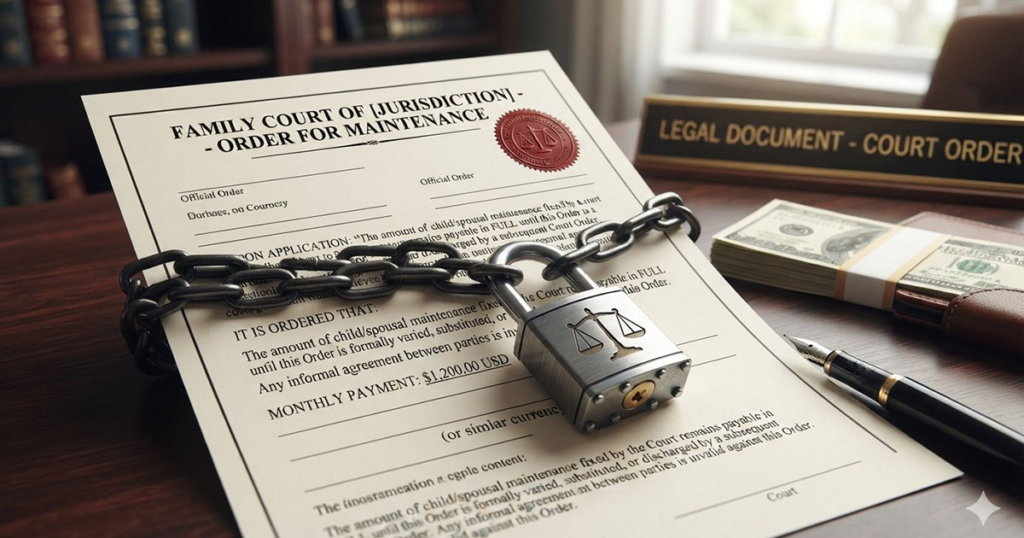
A maintenance order does not change automatically when your circumstances change. The amount fixed by the court remains payable in full until the order is formally varied, substituted or discharged by a court. This applies whether you are the parent paying maintenance or the parent relying on it.
Losing your job, suffering a reduction in income, having another child, or facing increased school and medical expenses does not, by itself, change what is legally payable under the existing order.
If your circumstances have changed materially, you may apply to the Maintenance Court for a variation. It is important to act promptly, preferably before payments are missed or the shortfall becomes unmanageable.
What Does the Maintenance Act Provide?
The Maintenance Act 99 of 1998 recognises that maintenance obligations and financial circumstances may change over time.
Under section 6(1)(b) of the Act, a complaint may be lodged where there is good cause for an existing maintenance order to be substituted or discharged. After investigating the complaint and holding an enquiry, the Maintenance Court may, under section 16, replace the existing order with a new order, discharge it, or decline to make any change.
When maintenance for a child is considered, section 15 requires the court to consider:
- The child's reasonable needs for proper living and upbringing, including food, clothing, accommodation, medical care and education
- The fact that both parents have a joint duty to support the child
- Each parent's respective financial means
- What would be fair in all the circumstances
The court therefore considers the complete financial position of both parents together with the child's reasonable needs.
Common Reasons for Seeking a Variation
A court may increase or reduce maintenance or, in appropriate circumstances, discharge an order where good cause is established. Common reasons include:
- Retrenchment, unemployment or a serious and genuine reduction in the paying parent's income
- A substantial improvement in either parent's financial position
- Increased costs relating to the child, including school fees, uniforms, stationery, extramural activities and medical or dental expenses
- A change in the child's primary residence or in the care arrangements
- A change in financial responsibilities of either parent
- New dependants whose reasonable needs must also be considered
Having another child does not automatically justify reducing the maintenance payable for an existing child. The court must consider the needs of all the children concerned, the parents' respective means and what is fair in the circumstances.
Do Not Simply Stop Paying
This is critical: an existing maintenance order remains binding and enforceable until a court formally changes it. Lodging an application for variation does not, on its own, suspend the existing order.
Reducing, delaying or stopping payments without a new court order creates arrears. Those arrears do not disappear merely because your financial position has changed or because a variation application is pending.
Under sections 26 to 30 of the Maintenance Act, outstanding maintenance may be enforced through:
- A warrant of execution against movable and, where necessary, immovable property
- An attachment of emoluments, allowing deductions from salary or wages
- The attachment of a debt owing to the defaulting party
A failure to comply with a maintenance order may also constitute a criminal offence under section 31 of the Act.
If you genuinely cannot afford the current order, applying for a variation places you in a far better position than simply falling into arrears and trying to explain the non-payment later.
How Does the Application Work?
An application to substitute or discharge an existing maintenance order is generally initiated by completing the prescribed Form B and lodging it with the Maintenance Court. The form records the existing order, the change in circumstances and the variation being requested.
The process generally involves:
- Lodging the prescribed complaint with the maintenance officer
- An investigation into the financial circumstances of the parties
- Submission of supporting financial documents
- Attendance at a maintenance enquiry
- An opportunity for the parties to reach an agreement
- If no agreement is reached, a hearing at which the court determines whether the order should be substituted or discharged
If the existing order was made by another court, the maintenance officer can advise whether the order must first be transferred and registered at the Maintenance Court dealing with the application.
What Documents Will You Need?
The strength of a variation application depends largely on the available financial evidence. You should, where applicable, bring:
- A copy of the existing maintenance order
- Your identity document and the child's birth certificate
- Recent payslips or proof of income
- Bank statements
- Proof of retrenchment, unemployment, UIF benefits or reduced working hours
- A detailed schedule of monthly income and expenditure
- Proof of the child's expenses
- School fee statements and invoices for uniforms, stationery and activities
- Medical aid statements and proof of medical or dental expenses
- Proof of rent, bond repayments and household expenses
- Proof of any new financial obligations or dependants
- Any documents supporting the change in circumstances on which you rely
Both parents should be prepared to provide full and honest financial disclosure. The court is entitled to consider the financial position of everyone affected by the maintenance obligation.
Why These Questions Often Arise Toward Year-End
The financial pressure associated with maintenance often becomes more apparent toward the end of the year. New school fees, uniforms, stationery, extramural costs and clothing expenses may all arise at once, often on top of festive-season expenditure.
This may be when a paying parent realises that the existing order is no longer affordable, or when a receiving parent realises that the amount no longer meets the child's reasonable needs.
Do not wait until January or until arrears have accumulated. Maintenance proceedings can take time, and the existing order remains payable while the application is pending.
Talk to Us Before the Payment Becomes Overdue
Whether you are a paying parent whose income has genuinely decreased or a receiving parent facing substantially higher costs, a variation application offers a lawful way to place the changed circumstances before the court.
Our Family Law team can assist you with:
- Assessing whether there is good cause for a variation
- Preparing the necessary documents
- Representing you during the Maintenance Court process
If your circumstances have changed, do not adjust the payments yourself. Speak to us before the next payment becomes overdue.
Get Legal Assistance
Our Family Law team is ready to help you navigate maintenance order variations with expertise and care.
Contact Hammond Pole Attorneys